Many users who use the modified version of Spotify to listen to audiobooks have noticed a common problem: the listening time seems to run out, and then they have to wait for the time to resume. This issue often causes confusion for Spotify audiobook users, especially since there is usually no clear indication of when the available listening hours will reset.
This article will explain in detail the working mechanism of audiobook listening time in these applications, the reasons for resetting time, and the factors that affect time. Our goal is to make this mechanism easier for users to understand, so they can understand what is expected.
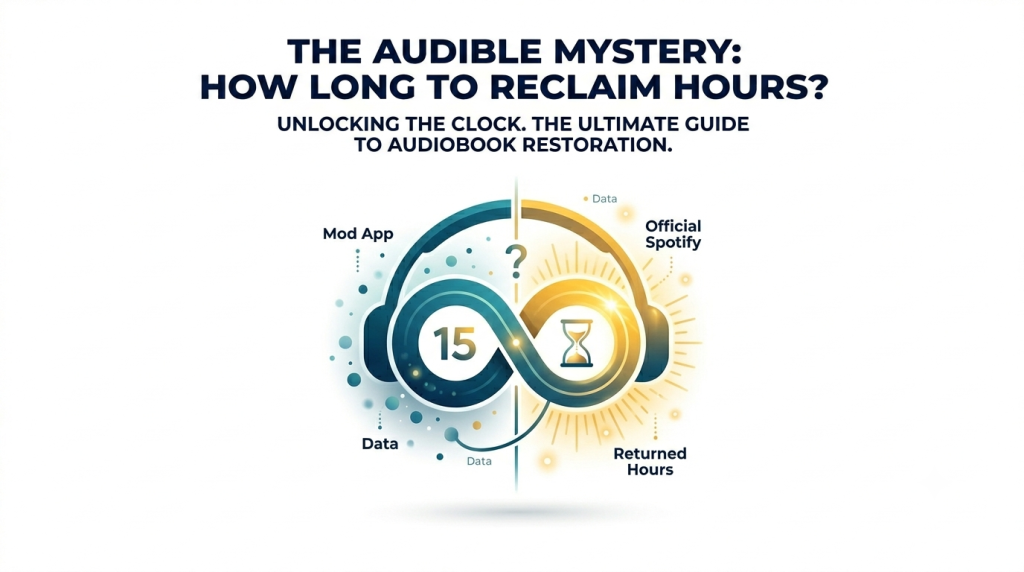
What “Audiobook Hours” Mean in Spotify Mod
In most modified versions of the Spotify app, “audiobook duration” refers to the limited amount of time a user can spend listening to audiobook content. The system will not charge based on the book title or unlock full access. Instead, it will record your listening time and deduct the corresponding time from the total listening time pool.
Every time you start listening to an audiobook, the app begins calculating your actual listening time. This typically includes continuous playback, whether you are listening attentively or letting it run in the background. Once the available time is used up, the audiobook playback function will be unavailable until the time is refreshed.
Unlike regular music playback, this duration is treated as a separate quota. This means that your ability to play songs will not be affected, but the number of visits to talking books on Spotify is controlled independently. The specific restrictions and tracking methods may vary depending on the application version, so the display and deduction of time may differ slightly between different versions.
Why Audiobook Hours Run Out
The length of an audiobook will decrease based on your listening time, not on chapters or titles, but on the actual playback time.
Common reasons hours run out quickly:
- Listening to long-form audiobooks in one sitting
- Leaving playback running in the background
- Replaying sections multiple times
- Streaming at higher quality settings that may be tracked differently in some versions
Because of this, users often feel like hours disappear faster than expected.
How Long It Usually Takes for Hours to Come Back
Although there are no uniform rules across all modified Spotify apps, most users have reported some common patterns.
1. Daily Reset Pattern
Some versions refresh the audiobook duration every 24 hours. In this case, the time limit will be restored at roughly the same time each day, depending on the time when the time limit was first used up or the time of the last system update.
2. Rolling 24-Hour Window
Some systems do not use the midnight time reset method, but instead use a rolling window. This means that time will gradually recover over time.
This system gives the feeling that time is “gradually recovering” rather than being completely reset all at once.
3. Batch Refresh System
In some cases, hours return in batches. This means:
- You may see no change for several hours
- Then suddenly a full set of hours appears again
This can make the timing feel random, but it usually follows internal updates rather than user action.
Why Timing Can Feel Inconsistent
Even with similar system configurations, users often notice delays or irregular restarts. There are many reasons for this situation.
1. App Sync Delays
Modified apps sometimes update usage data in batches instead of in real time. This means that your actual usage may not immediately match the data displayed by the application.
2. Background Activity
If the application continues to play or remains active in the background, it may continue to count time even if you don’t look at the screen.
3. Multiple Device Use
If the same account is used on different devices, usage tracking information may not be updated in sync across all devices.
4. Cache and Stored Data
Some versions rely on locally stored data. If this data is updated late, hourly resets may also be delayed.
Do All Audiobooks Count the Same
This is not always the case. Even though all the interfaces within an app look the same, the way audiobook usage is tracked is not always exactly the same. The differences usually stem from how the system tags and processes the content.
In many cases, the full audiobook will be counted normally, and the listening time will be reduced in a standard manner when using spotify premium audiobooks. However, shorter content, such as previews, sample clips, or partial recordings, may not reduce listening time at all, or may only be partially counted depending on how it is played.
Therefore, users may sometimes notice that certain content “takes longer” or “counts incorrectly,” but this is usually just due to different tracking methods, rather than the content itself being treated differently.
In short, the listening time of audiobooks is not always calculated in a completely uniform way; subtle differences in content type or playback method can affect the counting results.
What Users Commonly Expect vs Reality
Many users expect audiobook hours to reset at a fixed time like midnight. In practice, it rarely works that way.
Here is the difference:
Expectation:
- Hours reset at a clear time every day
- Usage is easy to predict
Reality:
- Reset timing can shift
- Hours may return gradually
- Updates may appear late or in batches
Understanding this helps reduce confusion when checking your remaining time.
How to Check If Hours Have Refreshed
In most cases, the listening time for audiobooks is not explicitly notified, so users need to check it manually. Although the tips are usually simple, there are a few things to keep in mind.
1. Try Playing an Audiobook Again
The most direct way is to start playing any audiobook. If playback returns to normal, it usually means the time has been refreshed. If playback stops or a limit is displayed, it means the time has not been refreshed.
2. Check the Remaining Time Indicator
Many versions will display a small counter or use a progress bar. When the time is reset, this number will either increase or revert to its default value. If it remains unchanged for a long time, it may not have been updated.
3. Restart the App
Sometimes data only updates after you reopen the app. If you suspect your data has been reset, please close the app completely and reopen it, then check the audiobook section.
4. Look for Sudden Changes in Availability
In some cases, you may find that previously blocked audiobooks can be played again. This is usually one of the most obvious signs of a time refresh.
5. Wait and Recheck After Some Time
If there are no changes, you can wait a moment and check again. Updates are not always displayed on the screen immediately.
Simple Example of a Reset Cycle
To make it clearer, here is a basic example:
- 10:00 AM — user starts listening
- 12:00 PM — 2 hours used
- 2:00 PM — more listening continues
- 4:00 PM — hours reach zero
- Next day afternoon — hours appear again
In this case, the return time depends on when the system completes its next update cycle, not necessarily when the hours ran out.
Conclusions
Audiobook playback times in the modified Spotify app do not follow a strict, fixed schedule. In most cases, the playback time will be updated in a daily cycle, but the specific time will vary depending on how the system tracks usage. If you also enjoy exploring spotify audiobooks best recommendations, you may notice that playback tracking behaves the same regardless of which audiobook you choose.
Some users will see a clean reset after 24 hours, while others will notice a rolling update or a delayed update. Therefore, the best way to understand this system is to think about it in terms of cycles rather than fixed times.
Once you realize that playback times are flexible, it becomes easier to predict when the next batch of audiobooks will be available.