At first glance, Spotify seems very flexible. You can download this app on your phone, laptop, tablet, smart TV, or even a game console. It seems there are no restrictions. To some extent, that is indeed the case. But once you start using it on multiple devices, you’ll discover that there are some important rules in the background that determine how it actually works, and even options like the Spotify family plan are designed around these limits rather than removing them entirely, shaping how accounts and playback behave across different devices.
Understanding these rules can help avoid confusion, especially when music suddenly stops playing or a device fails to play the content you expect.
Installation is not the same as usage
One of the most misunderstood aspects of Spotify is the gap between installing the app and actually using it. On the surface, after downloading Spotify, everything seemed to be ready, but in reality many users only start to understand the actual setup and listening experience once they explore options like Spotify Premium Family, which can change how accounts are shared and how smoothly playback is managed across different devices and users.
The icon is displayed, the account is logged in, and the playlist has been synced. This gives the illusion that all devices are active. But in reality, installation is just the beginning, not the true standard for measuring how the system works.
Installing an app simply means that the app exists on the device; it does not mean that the device plays an equal role in the playback process. A phone that had Spotify installed a year ago but had never been turned on since is no different from a brand new laptop with the app just installed. They are only “activated” when you actually start listening to them.
And that is precisely the key to its use case. Usage status does not refer to whether the device is present, but rather whether it is active. When you press play, you’re not just opening a song, you’re creating a live session linked to your account. Spotify will track this session across all devices. It determines which device is currently controlling playback and which devices are in standby mode.
Because of this architecture, multiple installed devices do not operate independently. Instead, they are like different connection endpoints within the same system. Even if ten devices are logged in and ready, only one endpoint can gain control at a time.
The real limit: one active stream
The most important rule of Spotify’s device system is simple: an account can only have one playback session at a time. This sounds simple, but it almost entirely determines the user experience when switching between different devices.
To make it clearer, here’s how this rule works in different situations:
1. Only one device can “own” playback at a time
When you press the play button on a device, that device becomes the currently active device. If music is already playing on another device, the current playback will be interrupted and switched to that device.
Split-screen playback or parallel listening is not supported under the same account. The system is built on a single “active control point”.
2. Switching devices is automatic, not additive
Spotify does not treat devices as separate audio channels, but rather as interchangeable controllers for the same audio stream.
Therefore, when you switch from your phone to a speaker or laptop, you are not creating a second audio stream, but rather reassigning the same audio stream.
3. Background apps still count as active sessions
Even if the application is running silently in the background, it can still maintain the current playback state.
The key is that Spotify tracks the actual playback status, not just what you are currently viewing.
4. Device control is shared, but playback is not
You can view and control multiple devices through a single account interface, especially when using Spotify Connect. It appears as if multiple devices are in a “ready” state simultaneously.
In reality, only one device can output sound at any given time. The remaining devices are basically in standby mode, ready to take over the output when selected.
5. The system prioritizes the most recent action
When multiple devices attempt to play simultaneously, Spotify follows a simple rule: the most recent instruction takes precedence.
There are no queues between devices. Each new operation will overwrite the previous operation.
6. Why it feels more flexible than it is
Despite the strict rules, the game often feels very flexible due to its fast and smooth switching. Switching between different devices is virtually lag-free, giving the impression of playing multiple video streams simultaneously.
Offline downloads have their own limits
The offline listening function adds another innovative feature.
If you download songs for offline use, Spotify allows each account to download them on up to 5 devices. These devices include mobile phones, tablets, or computers.
But there are rules:
- You must go online at least once every 30 days for downloads to stay active
- If you exceed 5 devices, older downloads may be removed automatically
- Downloads are tied to your account, not permanently stored on the device
This means offline listening is convenient, but not unlimited across devices either.
Device switching is seamless—but not simultaneous
One of Spotify’s most notable advantages is its seamless switching between devices. You can start playing a song on your phone and then continue listening on your laptop, smart speaker, or even TV without having to search again or restart playback, and this becomes even more convenient when using a Spotify Premium family plan, especially in households where multiple people share one subscription while keeping their own listening experience separate.
This is thanks to Spotify Connect, which displays all connected devices in a single list. Switching devices usually only requires a single tap. Music can be paused on one device and resumed almost instantly on another device, maintaining the same track, playback position, and volume.
The secret to this smooth experience is that Spotify remembers your listening status in real time. You won’t lose your podcast or playlist playback progress, and you don’t need to manually sync any content. The music seems to follow you as you switch from one device to another.
However, the key point is that this is still a single session. Even if your account is connected to multiple devices, it can only play on one device at a time. Therefore, the experience is continuous, but not played in parallel.
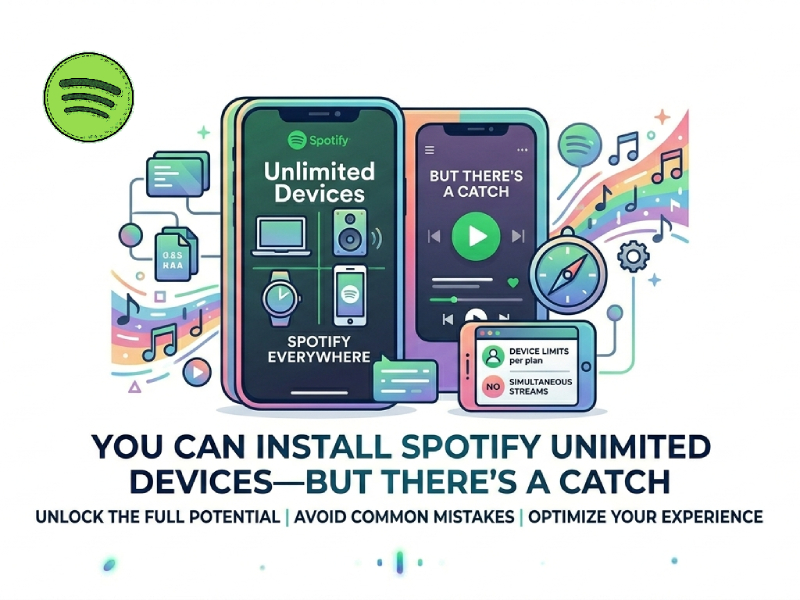
Why Spotify allows unlimited installations
One of Spotify’s most unexpected design choices is allowing users to install the app on virtually any number of devices. There is no strict limit on the number of mobile phones, laptops, or tablets on which the app can be downloaded, because installation and actual usage are treated separately within the system. This flexibility also explains why account management becomes more important than device control, especially when users move between different gadgets throughout the day or share access across households through options like a Spotify Premium family subscription, while still keeping playback restrictions tied to active streaming rather than installations.
Spotify wants users to switch devices frequently throughout the day. For example, someone might listen to music on their phone during their commute, switch to their laptop at work, and then play it on the TV or stereo when they get home. Widespread installation allows for a seamless switching experience without requiring re-login or any additional setup.
Another reason is that the app itself is lightweight and can be distributed for free. Restricting downloads won’t actually improve performance or user experience; instead, it will only create unnecessary problems.
The real control occurs during playback, not during installation. Spotify focuses on managing how music is played, rather than where the app is installed. This maintains the system’s simplicity while providing users with clear listening rules.
Smart devices add another layer
Modern setups often include smart speakers, TVs, and car systems.
In these cases:
- You can link many devices to your account
- You can switch playback between them easily
- But only one device plays at a time
For example, you can pause the music on your phone and then continue playing it on a speaker in another room. It feels like an expanded playback range, but it’s still a continuous audio stream, not multiple audio streams.
FAQ
1. Can I install Spotify on as many devices as I want?
Yes, you can install it on a variety of different devices. There are no strict public restrictions on the number of installations.
2. Why does my music stop when I play on another device?
Because one account can only support one playback session at a time, the concert started playing on the new equipment, transferring control.
3. Can I listen on two devices at the same time?
Under normal use, the two cannot be linked to the same account. Only one device can play music at a time.
4. How many devices can I download music on?
You can download songs for offline listening on up to 5 devices per account.
5. Does Spotify remember all my devices?
Yes, it can recognize devices you’ve used before, especially when connected via Spotify Connect.
6. Why does switching devices feel so smooth?
Because Spotify Connect allows devices to instantly pass playback control, the transition feels seamless even when only one stream is active.
Final thoughts
Spotify offers a great deal of freedom in terms of device selection. You can install it almost anywhere you use electronic devices, and switching between devices is effortless, which also makes options like a Spotify family account especially convenient for households that want to share access while still keeping individual listening preferences separate.
However, this freedom comes with its limitations. The “limitation” is not about how many devices you can use, but about the number of devices playing simultaneously.
Once you understand this, the Spotify experience becomes clear, smooth, and no longer confusing. It doesn’t truly allow you to listen to music anytime, anywhere, indefinitely; rather, it means you can only enjoy music smoothly on one device at a time.