For many, audiobooks have become a part of daily life. Some people listen to it during their commute, some listen to it while cooking, and some listen to it to relax before bed. Among the many audiobook platforms, Spotify audiobooks and Audible are the two most popular choices.
At first glance, they seem very similar. Both offer a vast library of audiobooks, support mobile devices, and are easy to use. However, after using them for a while, a key difference will emerge: they were designed to meet very different listening habits.
In the last article, we discussed whether Spotify Premium can tell you your music Soulmate. This difference creates a trade-off that many listeners don’t initially notice.
1. Two Different Ideas Behind the Same Product
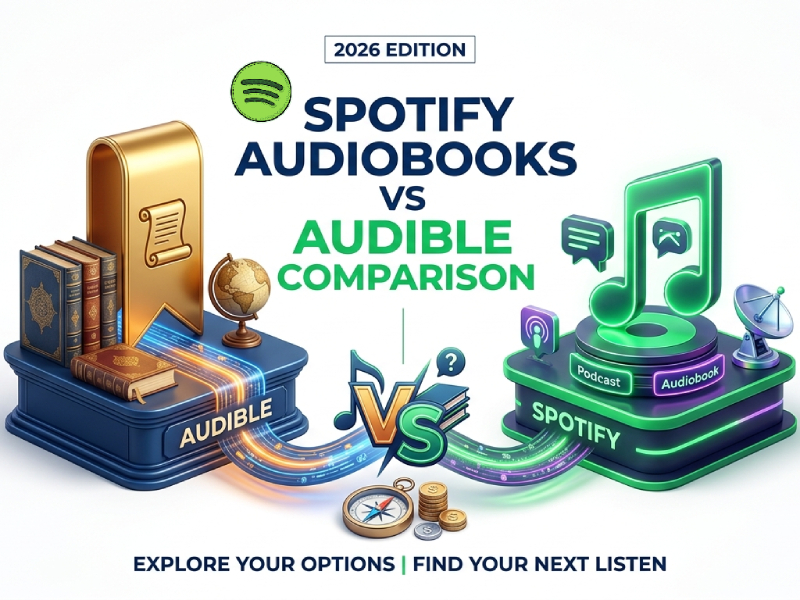
Although both Spotify Audiobooks and Audible offer audiobooks, their product philosophies are quite different, with Spotify Audiobooks, where listeners may find titles like Harry Potter audiobook Spotify, and Audible taking very different approaches to catalog access and discovery. This difference affects every aspect, from browsing methods and payment methods to the daily listening experience.
1) Spotify: an “all-in-one audio space” idea
Spotify considers audiobooks as part of its vast audio ecosystem. Its main goal is not only to get users to read books, but also to keep users on the same platform for as long as possible. Music, podcasts, and audiobooks are all integrated into a single app, allowing users to easily switch between different content.
This design embodies the concept of a “streaming lifestyle”: users are not just there to listen to audiobooks, but to choose any type of audio content based on their mood or current situation.
2) Audible: a “reading replacement” idea
Audible’s design goals are more clearly defined. It views audiobooks as a core product, rather than an add-on service. Its structure is closer to traditional reading habits, with each book representing a clear commitment.
Audible does not encourage users to frequently switch between content types, but instead guides users to focus on one book for an extended period of time, just like reading a physical book.
3) Different expectations about user attention
Spotify assumes that users’ attention is flexible and scattered. Users might listen to music first, then podcasts, and then switch to audiobooks within a few minutes. The system is designed to support this smooth switching.
Audible, on the other hand, assumes that users’ attention is more stable. Users need to listen to a story or argument for hours or even days at a time, with almost no interruptions between each listening session.
In short, Spotify’s design philosophy is to provide a rich selection of audio content, while Audible’s design philosophy is to allow users to focus on reading. This core difference subtly influences every aspect of the user experience, even if the audiobook catalogs appear very similar on the surface.
2. Library Depth vs Access Flexibility
One of the most important differences between Spotify Audiobooks and Audible lies in how they handle book access. On the surface, both offer vast libraries of books. But in actual use, the way you “access” these books is quite different.
1. Audible focuses on ownership through credits
Audible uses a points system. Each month, you will earn points that can be redeemed for audiobooks, usually without price restrictions. This makes you feel more at home after you make the purchase.
- One credit usually equals one full audiobook
- New releases and premium titles are often included
- Once redeemed, the book stays in your library
This makes the user experience closer to buying a physical book, even though it is still a subscription model. Over time, users can create a personal digital bookshelf to store books they have finished reading and return to them at any time.
2. Spotify focuses on access within limits
Spotify takes a different approach. It doesn’t use points; instead, it links audiobook listening access to a subscription service. This means you can’t “collect” books in the same way.
- Access is often based on listening time or plan type
- The catalog feels more fluid and streaming-like
- Switching between books, podcasts, and music is seamless
This model is more like renting audio access rights than building a permanent audio library. It is suitable for users who occasionally listen to audio or switch between different types of audio content.
3. Depth vs flexibility in real use
The key trade-off becomes clearer in daily listening habits:
- Audible gives you depth: fewer limits on how you use your credits, stronger focus on finishing full books
- Spotify gives you flexibility: easier to jump in and out of audiobooks without thinking about “spending” credits
So the experience is shaped by what you value more—structured reading or free-flowing listening.
3. Listening Experience: Built for Different Habits
Audible feels like a reading app. Its design philosophy is to allow users to listen for extended periods, support chapter tracking and bookmarking functions, and steadily advance their reading progress, while other platforms often focus more on discovery-driven listening experiences such as best audiobooks Spotify playlists that encourage casual browsing rather than structured progression.
Spotify feels like a streaming app. You can seamlessly switch between music, podcasts, and audiobooks.
Both methods have their merits, but they will affect how you acquire the story.
If your goal is to finish reading a novel or non-fiction book, Audible will help you feel more focused. If your goal is to listen easily and intersperse with some music and podcasts, Spotify will make you feel more at ease.
4. Cost Structure: Predictability vs Bundling
In terms of cost, the difference between the two is not always so obvious.
Audible typically uses a subscription model with a points system. The value of points depends on the number of books you listen to and the price of each book.
Spotify Audiobooks are typically included in larger subscription plans, meaning you’re not paying for just the books, but for a suite of audio services.
Here is a simple comparison:
| Feature | Spotify Audiobooks | Audible |
| Main model | Subscription bundle | Credit-based subscription |
| Payment focus | One plan for all audio | Pay for audiobook access |
| Cost predictability | Medium (depends on usage limits) | High (fixed credits per month) |
| Best for | Mixed listening habits | Heavy audiobook readers |
The hidden trade-off here is control versus simplicity. Audible gives more control over what you “spend” on books. Spotify gives more simplicity by combining everything into one plan.
5. Discovery and Recommendations
In everyday use, the discovery experience of Spotify and Audible differs significantly, even though they both eventually lead you to similar audiobooks.
On Spotify, the discovery feature is largely dependent on your overall listening habits. Because the platform tracks your listening history across music, podcasts, and audiobooks, its recommendations are based on listening patterns rather than categories. For example, if you frequently listen to long podcasts about business or storytelling, the system may recommend audiobooks with similar themes or narrative styles. This creates a more “automatic” discovery process, where new books appear naturally without you having to actively search for them.
On Audible, the features are more structured and purposeful. The platform relies heavily on curated lists, category pages, and editorial recommendations. It doesn’t lump together all audio behaviors, but focuses primarily on what you’re reading or searching for in the audiobook library. This makes the recommendations more stable and easier to control. If you are interested in a specific topic, such as psychology, science, or classic literature, you can quickly find a clear list of relevant books without being overwhelmed.
In short, Spotify tends to be passively discovered based on users’ behavior across multiple media types, while Audible tends to be proactively discovered based on structured reading interests. The former leans more towards exploration and spontaneity, while the latter leans more towards focus and control.
6. Audio Quality and Narration Focus
Spotify Audiobooks and Audible offer excellent audio quality overall, but they differ slightly in narration and production. This difference may not be obvious at first, but it will gradually become apparent as you listen to more and more audiobooks.
Audible has been dedicated to building a robust audiobook ecosystem for many years, so most of its audiobook library is designed for listening rather than reading. Many of the works are recorded in specialized recording studios by professional narrators who pay attention to rhythm, tone, and character development. In longer non-fiction books, narration is usually smooth and consistent, which helps listeners understand complex concepts without being disturbed. In fictional works, voice acting can be more expressive, especially in popular works, because the quality of the performance is key to the experience.
In contrast, Spotify Audiobooks operates on a broader audio platform that also includes music and podcasts, including Spotify Premium audiobooks. Therefore, its audiobook library has a more diverse production style. Some works are well-produced with professional narration, while others are more concise and clear. Spotify Audiobooks tend to focus on ease of use and versatility rather than a uniform production standard.
For listeners who value immersion and consistency in voice performance, Audible often feels more precise and attentive. For listeners who enjoy freely switching between different formats and listening attentively, Spotify creates a more casual atmosphere while ensuring sufficient sound quality.
7. Final Thought
Both platforms address the same fundamental problem: how to read books more easily in a busy life. But their solutions are quite different.
One platform integrates audiobooks into a richer entertainment experience, while the other platform is closer to traditional reading habits.
This hidden trade-off is not immediately obvious. It will only become apparent after you have used both platforms simultaneously for a period of time and noticed a change in your listening habits.
Once you realize this, the key to choosing is no longer the features, but what kind of audience you are.